City commences with modification of Zeekoevlei weir
08 April 2026
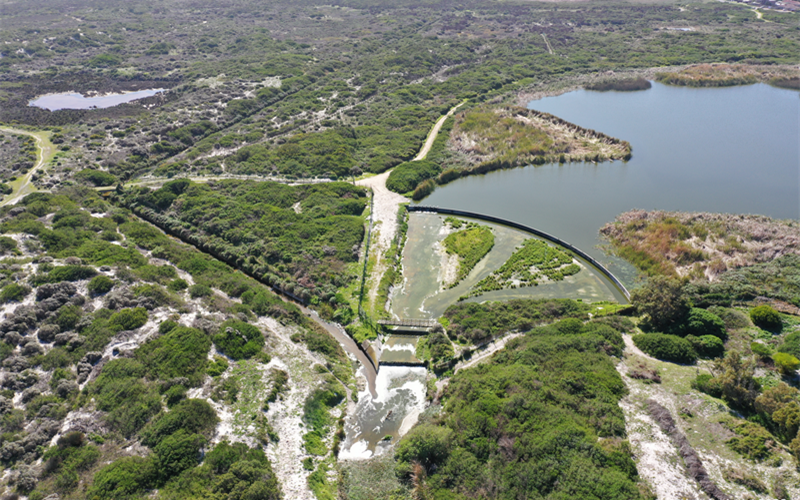
The City of Cape Town has commenced with the modification and upgrade of the weir at Zeekoevlei in the False Bay Nature Reserve. This project will strengthen other medium-term interventions to improve the overall water quality of this Ramsar site.
The False Bay Nature Reserve is a site of international importance according to the Ramsar Convention on Wetlands.
The modification of the weir will support the City's medium-term interventions, amongst which the current dredging of Home Bay and Storm Bay to remove the nutrient-rich sediment in Zeekoevlei. Also, by improving the water level management and facilitating more effective flushing of nutrients and pollutants, the overall condition and functioning of the system can be improved, and water quality enhanced.
The contractor is currently setting up the site camp and busy preparing for the works that will commence in all earnest by May 2026. If all goes as planned, the project should be complete by mid-2027.
‘Improving the water quality of our vleis remains one of our top-priorities and the weir project is key to achieving this outcome. The project entails the lowering of the weir at Zeekoevlei and to install mechanically operated sluice gates, as opposed to the current systems where we remove the penstocks manually for the drawdown. With mechanically operated sluice gates, the operations will be streamlined, and the lowered weir crest will allow for a deeper drawdown of the vlei water. The deeper drawdown will enable us to better manage organic sediment and reeds, and we will be able to more fully flush the vlei of nutrient-rich water and sediment.
'We will also be installing fishways to make it possible for natural estuarine fish to enter the vleis. In so doing, we aim to support the restoration of fish diversity and abundance when water quality improvements within the entire system allows for it. We are extremely excited about the possibility of having locally indigenous fish back in the vlei in the long-term,' said the City's Deputy Mayor and Mayoral Committee Member for Spatial Planning and Environment, Alderman Eddie Andrews.
The project entails the following:
Modification of the existing Zeekoevlei weir to allow more efficient and remote lowering of water levels when needed
The redevelopment includes the lowering of the channel apron to facilitate the drawdown, expansion of the weir, new mechanical sluice gates, a gatehouse for maintenance, and stabilisation using gabions. When filled, Zeekoevlei is 5,18m above mean sea level, and the current sluice gate allows a drawdown to 4,3m. The modification will extend the weir westwards with a new set of sluice gates that lower the potential drawdown level to 3,5m
Construction of a fishway between the Zeekoevlei canal and the weirs so that fish can move into Zeekoevlei from the channel. The fish swim way will make it possible for indigenous freshwater and estuarine and marine fish to enter the vlei
Construction of a second fishway at the downstream bridge to allow access from the lower portion of the Zeekoe River past the existing sewer rising main bridge structure that currently prevents fish movement
Project benefits:
The redevelopment and modification of the weir will allow deeper and more flexible annual drawdowns of the Zeekoevlei to facilitate sludge and reed clearing, and oxygenation of exposed sludge
The new design will allow for a deeper drawdown level, which can assist significantly with the improvement of the water quality of the vlei
Both Zeekoevlei and Rondevlei are managed by a system of penstock sluice gates to allow for the water level to be dropped to a minimum depth, which is known as the annual 'drawdown', usually at the end of the summer sailing season. The intention of the drawdown is to remove nutrient-rich water and sediment from the system, and to increase the capacity of the vleis prior to the winter rainfall season to reduce the risk of flooding of surrounding areas.
The current manually operated weir limit the depth of water which can be drawn down. The weir walls, built in the 1950s, also prevent the movement of marine and estuarine fish into and from the vleis.
Caption: The modification of the weir at Zeekoevlei, located in the False Bay Nature Reserve, is one of the City's interventions to improve the overall water quality and estuarine life.
End
Published by:
City of Cape Town, Media Office